We rebuilt PromptSewa — and your prompts were reset
We rebuilt PromptSewa — and your prompts were reset
What happened
We moved PromptSewa to a new platform and rebuilt the prompt catalog from scratch. As part of that cleanup, every prompt in the library was removed, including prompts some of you had already bought.
That was our decision, and the cost landed on you. So we are putting it right.
What you get
5,000 Sikka added to every account — buyers, creators and free members alike.
A faster, cleaner catalog where every listing passes a quality review before it goes live.
Removed purchases stay in your purchase history: nothing you paid for is forgotten.
If something still looks wrong
Message support from the footer. A missing purchase or a missing Sikka balance is fixed first, and we answer every message.
From the team
We rebuilt PromptSewa — and your prompts were reset
What happened
We moved PromptSewa to a new platform and rebuilt the prompt catalog from scratch. As part of that cleanup, every prompt in the library was removed, including prompts some of you had already bought.
That was our decision, and the cost landed on you. So we are putting it right.
What you get
5,000 Sikka added to every account — buyers, creators and free members alike.
A faster, cleaner catalog where every listing passes a quality review before it goes live.
Removed purchases stay in your purchase history: nothing you paid for is forgotten.
If something still looks wrong
Message support from the footer. A missing purchase or a missing Sikka balance is fixed first, and we answer every message.
An AI prompt is the instruction you give a large language model, image generator, video model, or autonomous agent to produce a specific output. In 2026 a prompt can be a single sentence, a multi-step workflow, a JSON schema, or a chain of tool-use commands — but the core idea has not changed: you describe what you want, and the AI does its best to deliver it. This guide breaks down every major prompt type, shows you working examples, and explains what has changed since the "type a question into ChatGPT" era.
What Exactly Is an AI Prompt?
Strip away the marketing language and an AI prompt is an input designed to steer a model toward a particular output. That input can be:
Plain natural language ("Write a product description for a handmade ceramic mug").
A structured template with variables ("Summarise the following transcript in {{word_count}} words, output as JSON").
A sequence of instructions fed to an autonomous agent that plans, calls tools, and iterates without further human input.
A multi-modal brief combining a text description, a reference image, and an audio clip.
The model — whether it is GPT-5, Claude 4, Gemini 2, Qwen 3, DeepSeek-V4, or an open-weight Llama variant — processes your prompt, predicts the most relevant continuation, and returns a result. Your job is to make the input clear enough that the prediction lands where you want it.
Think of a prompt as a creative brief you would hand to a very fast, very literal junior colleague. The better the brief, the less revision you need.
How AI Prompts Work Under the Hood (2026 Edition)
You do not need a machine-learning degree to write good prompts, but knowing three mechanics helps you troubleshoot when output goes sideways.
Tokens, not words
Models read in tokens — chunks of roughly three-to-four English characters. A 500-word prompt is around 650–700 tokens. Every model has a context window (the maximum tokens it can consider at once). In 2026 the major frontier models handle 128 k to 1 million+ tokens, but longer context does not mean equal attention to every token. Front-load the most important instruction.
System, user, and tool layers
Most API-based interactions split a prompt into layers:
System prompt – persistent rules the model must obey ("You are a copywriting assistant. Never invent statistics.").
User prompt – your specific request for this turn.
Tool / function definitions – structured schemas the model can call to fetch data, run code, or trigger an external action.
Understanding these layers matters because a prompt that works in a chat UI may behave differently when you move it into an API call or an agent framework.
Temperature and sampling
A temperature setting (usually 0–2) controls randomness. Low temperature → deterministic, repeatable answers. High temperature → creative, varied output. If your prompt produces inconsistent results, check this setting before blaming the prompt itself.
Types of AI Prompts in 2026
The single biggest change since 2023 is that "prompt" no longer means only text typed into a chat box. Here are the major families people search for today.
1. Text prompts (LLM)
The classic. You ask a language model to write, summarise, translate, analyse, or reason. Quality depends on specificity, role framing, and output format instructions.
2. Image-generation prompts
Used with Midjourney, DALL·E 4, Flux, Ideogram, Stable Diffusion 4, and similar tools. A good image prompt typically specifies subject → style → lighting → lens/camera → aspect ratio → negative constraints.
3. Video-generation prompts
Sora 2, Veo 3, Kling 2, and Runway Gen-4 have made text-to-video a mainstream workflow. Video prompts add temporal language: camera movement, scene transitions, pacing, and duration cues.
4. Structured-output prompts
You instruct the model to return data in JSON, YAML, CSV, or a function-call schema. Essential for developers wiring LLMs into applications.
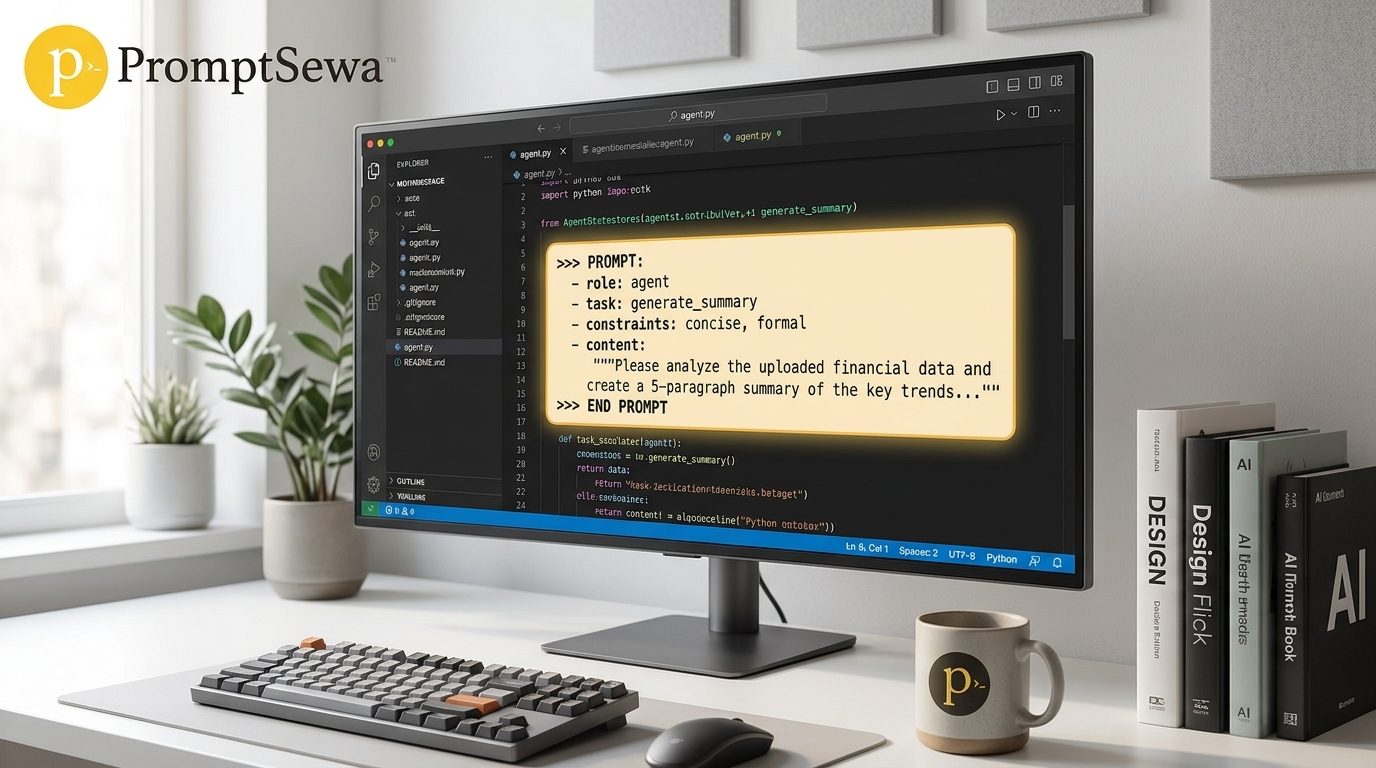
5. Agent / workflow prompts
Instead of a single instruction, you define a goal, available tools, constraints, and stopping criteria, then let the agent plan and execute multiple steps autonomously. This is the fastest-growing prompt category in 2026.
6. Multi-modal prompts
One prompt bundles text, an uploaded image, an audio sample, or a PDF. The model processes all inputs together. Useful for captioning, design critique, translation with context, and accessibility work.
7. Retrieval-Augmented Generation (RAG) prompts
You supply retrieved chunks from your own documents and instruct the model to answer only from those chunks. Common in enterprise knowledge bases and legal/compliance tools.
Prompt vs. Prompt Chain vs. Agent Instructions
Because these three terms get mixed up constantly, here is a quick comparison.
Single prompt
Prompt chain
Agent instructions
Steps
One input → one output
Multiple sequential prompts; output of step n feeds step n + 1
Prompt 1: extract key claims → Prompt 2: fact-check each claim → Prompt 3: write summary citing only verified claims.
"Research the top 5 competitors for [product], compile a comparison table, and draft a one-page brief. Use the web-search tool and the spreadsheet tool. Do not exceed 800 words."
If you are building anything beyond a one-off question, you are probably writing a chain or agent brief, not a single prompt. Design accordingly.
What Makes a Good AI Prompt?
Across every model family, five principles hold up.
Be specific about the output format. "Write a 120-word product description in a friendly tone, formatted as three short paragraphs" beats "Write something about this product."
Assign a role or perspective. "You are a senior UX researcher reviewing a mobile checkout flow" focuses the model's knowledge retrieval.
Provide constraints. Word limits, tone rules, things to avoid. Constraints reduce hallucination surface area.
Show, don't just tell. One or two examples of the desired output (few-shot prompting) outperform a paragraph of description.
Iterate deliberately. Save each version. Change one variable at a time. If you do not know why a prompt improved, you cannot replicate the improvement.
That last point is why prompt version control matters more in 2026 than it did two years ago. Models update; a prompt that worked in March may drift by September.
AI Prompt Examples You Can Copy Right Now
Below are original examples. Paste them into your model of choice, swap the bracketed variables, and adapt.
Text prompt — marketing email
text
Role: You are a B2B email copywriter for a SaaS company.

Task: Write a cold outreach email (max 130 words) to a Head of Operations
at a mid-size logistics firm. Introduce our route-optimisation platform,
[Routely]. Focus on one pain point: fuel-cost overruns on multi-stop
deliveries.

Constraints:
- Subject line ≤ 8 words, no clickbait.
- Include one concrete but plausible benefit statement (do NOT invent
  a statistic; use directional language like "teams typically report").
- End with a single, low-friction CTA (15-min call).
- Tone: professional, warm, zero jargon.

Output format:
Subject: …
Body: …
Image-generation prompt — product photography
text
A handcrafted ceramic coffee mug, matte sage-green glaze, sitting on a
light oak table. Soft morning window light from the left, shallow depth
of field, 50 mm lens look. Minimal styling: one linen napkin folded
beside the mug. Clean warm-white background. Aspect ratio 4:5.
No text, no watermark, no human hands.
Agent / workflow prompt — weekly competitor brief
text
Goal: Produce a one-page competitor brief every Monday.

Available tools:
- web_search(query)
- read_url(url)
- write_markdown(content)

Steps (you decide the order):
1. Search for news, product launches, and funding rounds for
   [Competitor A], [Competitor B], [Competitor C] from the past 7 days.
2. For each finding, open the source URL and extract: date, headline,
   one-sentence summary.
3. Compile a Markdown table: Competitor | Date | Headline | Summary.
4. Add a 3-bullet "So what?" section interpreting the moves.
5. Keep total output under 600 words.

Guardrails:
- Cite every claim with its source URL.
- If fewer than 3 items are found, say so explicitly. Do not pad.
- Do not speculate beyond what the sources state.
Structured-output prompt — JSON extraction
text
Read the following customer-support transcript and return ONLY valid JSON.

Schema:
{
  "customer_name": string,
  "issue_category": "billing" | "technical" | "shipping" | "other",
  "sentiment": "positive" | "neutral" | "negative",
  "summary": string (max 40 words),
  "suggested_action": string (max 20 words)
}

Transcript:
"""
{{paste_transcript_here}}
"""

Return no text outside the JSON object.
Each of the examples above is a starting template. For production use — especially agent workflows and structured outputs — you will want to test across at least two models, pin the model version in your code, and log outputs so you can spot regressions after a provider update.
A prompt rarely lives in isolation anymore. Typical placement:
Content teams keep a shared prompt library (marketing emails, SEO briefs, social captions) and pull from it daily.
Developers embed prompts in code alongside function-calling schemas, version them in Git, and run automated evals.
Designers pair image/video prompts with mood boards and iterate in tools like Midjourney, Flux, or Sora.
Operations / analysts wire agent prompts into orchestration platforms (n8n, Make, Zapier AI, LangGraph) so routine reports run without a human in the loop.
Freelancers and small studios in Nepal and South Asia are increasingly packaging niche prompt sets — Nepali-language content prompts, e-commerce listing prompts, education-focused prompts — and selling them on marketplaces. If that sounds like you, the PromptSewa seller page walks through listing, pricing, and payment options including eSewa and Khalti.
The common thread: the prompt is the reusable asset. Treat it like a small piece of intellectual property — version it, document it, and iterate on it deliberately.
Frequently Asked Questions
Do I need to learn coding to write AI prompts?
No. Plain-language prompts work for most writing, research, and image tasks. Coding knowledge helps when you move into structured outputs, API integrations, or agent tool-use definitions, but it is not a prerequisite.
Does the same prompt work on every AI model?
No. Models differ in training data, instruction-following style, and supported features. A prompt tuned for Claude may need re-wording for Gemini or Qwen. Test on your target model and keep model-specific notes. Anthropic publishes a prompt-engineering overview and OpenAI maintains a similar prompt-engineering guide — both are worth bookmarking.
Can I sell prompts I write?
Yes, provided the prompts are original and do not contain proprietary data. Marketplaces like PromptSewa let you list prompt packs, set a price, choose a licence, and receive payment. Buyers get version history and usage terms upfront.
What is the difference between a prompt and a system message?
A system message (or system prompt) sets persistent behaviour for the entire conversation or session — tone, rules, restrictions. A user prompt is the specific request within that session. In API calls they are sent as separate fields.
How often should I update my prompts?
Review them whenever the underlying model receives a major update, and at minimum every quarter. Small wording changes by the provider can shift output quality. Keeping versioned copies makes rollback painless.
Last verified: November 2026.
Try It on PromptSewa
You now know what an AI prompt is, the main types, and what separates a vague request from a well-engineered one. The fastest way to level up is to study prompts that already work, adapt them, and build your own library.
Browse ready-made prompts across marketing, coding, image generation, video, and agent workflows in the PromptSewa prompt library. Every listing includes the prompt text, target model, version history, and licence terms.
Explore agent and workflow prompts specifically in the AI Agent Prompts category if you are building multi-step automations.
Sell your own prompts. If you have a prompt set that solves a real problem — especially for Nepali-language content, e-commerce, or education — list it on PromptSewa and reach buyers in Nepal and the US.
Write the prompt. Test it. Version it. Share it. That is the whole discipline, and it starts with a single clear sentence.

Join the conversation
0 comments