We rebuilt PromptSewa — and your prompts were reset
We rebuilt PromptSewa — and your prompts were reset
What happened
We moved PromptSewa to a new platform and rebuilt the prompt catalog from scratch. As part of that cleanup, every prompt in the library was removed, including prompts some of you had already bought.
That was our decision, and the cost landed on you. So we are putting it right.
What you get
5,000 Sikka added to every account — buyers, creators and free members alike.
A faster, cleaner catalog where every listing passes a quality review before it goes live.
Removed purchases stay in your purchase history: nothing you paid for is forgotten.
If something still looks wrong
Message support from the footer. A missing purchase or a missing Sikka balance is fixed first, and we answer every message.
From the team
We rebuilt PromptSewa — and your prompts were reset
What happened
We moved PromptSewa to a new platform and rebuilt the prompt catalog from scratch. As part of that cleanup, every prompt in the library was removed, including prompts some of you had already bought.
That was our decision, and the cost landed on you. So we are putting it right.
What you get
5,000 Sikka added to every account — buyers, creators and free members alike.
A faster, cleaner catalog where every listing passes a quality review before it goes live.
Removed purchases stay in your purchase history: nothing you paid for is forgotten.
If something still looks wrong
Message support from the footer. A missing purchase or a missing Sikka balance is fixed first, and we answer every message.
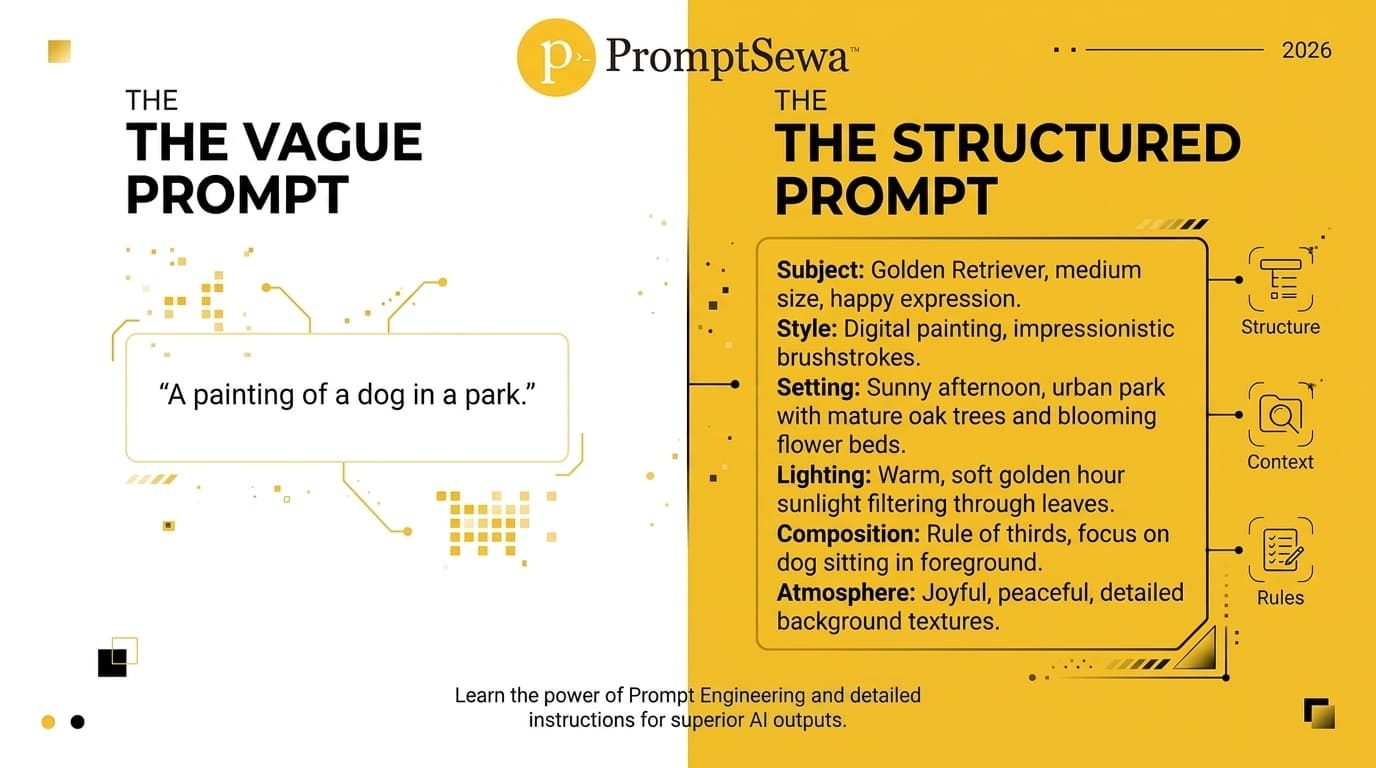
Prompt engineering is the practice of writing clear, structured instructions so an AI model returns exactly the output you need — on the first try, every time. In 2026 it covers text prompts, image and video generation briefs, structured JSON schemas, multi-step agent workflows, and multi-modal inputs. You do not need a computer-science degree. You need twelve repeatable rules. This guide walks through each one with copy-paste examples you can adapt in under five minutes.
What Is Prompt Engineering in 2026 — And Why Does It Still Matter?
Models are smarter than they were two years ago. Context windows stretch past 100 k tokens. Agents plan their own steps. So why does prompt engineering still matter?
Because the gap between a mediocre output and a great one is almost always the prompt, not the model. A vague instruction produces a vague answer on GPT-5 just as it did on GPT-3.5. What has changed is the surface area: you are now engineering prompts for agents that call tools, for video generators that need temporal language, and for structured pipelines that must return valid JSON every single run.
The twelve rules below are model-agnostic. They work whether you are writing for Claude, Gemini, Qwen, DeepSeek, Llama, Mistral, or an open-source fine-tune. They also scale from a single chat message to a production agent system.
Tell the model what shape the answer should take before you describe the topic. Format-first prompting eliminates 80 % of "that's not what I meant" revisions.
Weak:
Write something about solar panels for homeowners.
Strong:
text
Format: 3 short paragraphs (max 60 words each), followed by a
bulleted list of 5 FAQs with one-line answers.

Topic: Residential solar panels — cost, savings timeline, and
common misconceptions for first-time buyers in [country].

Tone: Conversational, no jargon.
When you know the exact structure you need — table, JSON, numbered list, Markdown heading hierarchy — state it in the first line.
Rule 2 — Assign a role with constraints
"Act as a copywriter" is a start. "Act as a B2B SaaS copywriter who never uses exclamation marks and always includes one data-backed claim" is a prompt that produces usable first drafts.
text
Role: You are a senior UX researcher specialising in mobile
checkout flows for e-commerce apps.

Constraints:
- Reference only patterns documented in published usability
  research. Do not invent statistics.
- Keep recommendations to 5 items max.
- Flag any recommendation that requires engineering effort
  beyond front-end CSS changes.
The role focuses retrieval; the constraints prevent drift.
Rule 3 — Use few-shot examples
One or two examples of the desired output outperform a paragraph of description. This is the single highest-leverage technique for consistency.
text
Classify the sentiment of each review. Return ONLY one word
per review: positive, negative, or neutral.

Example 1:
Review: "Shipping was fast and the fabric feels premium."
Sentiment: positive

Example 2:
Review: "The zipper broke after two days. Returning it."
Sentiment: negative

Now classify:
Review: "{{insert_review_here}}"
Sentiment:
Two examples are usually enough. Five examples rarely help further and just consume context tokens.
Rule 4 — Break complex tasks into prompt chains
If a task has more than three logical steps, do not cram it into one prompt. Chain them. Output of step n becomes input for step n + 1.
text
--- PROMPT 1: Research ---
List the 7 most-cited objections to remote-work policies from
published HR surveys (2023–2026). For each, give a one-line
summary and the source name. Output as a numbered list.

--- PROMPT 2: Rebuttal draft ---
Using ONLY the list from Prompt 1, write a one-paragraph
counter-argument for each objection. Keep each paragraph under
80 words. Cite the source inline.

--- PROMPT 3: Final memo ---
Compile Prompts 1 and 2 into a 1-page internal memo addressed
to the leadership team. Add a 3-bullet executive summary at
the top. Tone: confident, evidence-based, non-confrontational.
Chains give you checkpoints. If step 2 goes sideways you fix step 2 without re-running the whole pipeline.
Rule 5 — Constrain to reduce hallucination
Every open-ended dimension in your prompt is a dimension the model can fill with invention. Close the gaps.
Useful constraint phrases:
"Use only the information provided below."
"If you are unsure, say 'I don't have enough information' rather than guessing."
"Do not include any statistic that is not present in the source text."
"Limit your answer to {{n}} words / {{n}} bullet points."
In 2026 most frontier models offer a "thinking" or "reasoning" mode (extended chain-of-thought) alongside a fast default mode. Tell the model which to use.
text
Reasoning mode: step-by-step. Show your work before the
final answer.

Problem: A logistics company ships 12,400 parcels per week.
Fuel cost rose 18 % in Q3 while parcel volume grew 7 %.
If revenue per parcel stayed flat, what is the net margin
impact? State assumptions clearly.
For creative tasks (brainstorming, fiction, naming), switch to: "Answer intuitively. Do not show step-by-step reasoning." Matching the reasoning mode to the task type prevents over-analysed creative briefs and under-reasoned analytical ones.
Rule 7 — Use structured schemas for data tasks
If the output feeds a database, API, or spreadsheet, define the schema explicitly. Do not rely on the model to "figure out" your columns.
text
Return ONLY valid JSON matching this schema:

{
  "company_name": "string",
  "funding_round": "seed | series_a | series_b | series_c | later",
  "amount_usd": "number or null",
  "lead_investor": "string or null",
  "date": "YYYY-MM-DD or null",
  "source_url": "string"
}

Rules:
- If a field is not found in the text, use null. Do not guess.
- Output no markdown, no commentary, no code fences.
  Only the JSON object.
This rule pairs naturally with agent tool-use definitions and function-calling prompts. See the AI Agent Prompts category on PromptSewa for production-ready schemas.
Rule 8 — Write for the agent, not just the model
When your prompt drives an autonomous agent (in n8n, LangGraph, CrewAI, or a custom orchestrator), you must specify:
Goal – the final deliverable.
Available tools – named explicitly.
Stopping criteria – when the agent should halt.
Guardrails – what it must not do.
text
Goal: Produce a 500-word blog outline on "AI in Nepali
agriculture" optimised for the keyword "ai tools nepal
farming".

Tools available:
- web_search(query)
- read_url(url)
- write_markdown(content)

Stopping criteria: Stop after the outline is complete.
Do NOT write the full article.

Guardrails:
- Do not fabricate statistics. If no source supports a
  claim, omit it.
- Do not exceed 5 web searches.
- Output must be valid Markdown with H2/H3 headings only.
Without stopping criteria and guardrails, agents loop, over-fetch, or invent.
Rule 9 — Version and label every prompt
Treat prompts like code. Tag them.
text
# Prompt ID: MKT-EMAIL-014
# Version: 2.3
# Target model: Claude 4 Sonnet (also tested on GPT-5)
# Last updated: 2026-10-28
# Change log:
#   2.3 – Added constraint: no exclamation marks in subject line
#   2.2 – Switched from 150-word to 120-word body limit
#   2.1 – Added few-shot example for CTA line

[actual prompt text below]
If a model update changes output quality, you can diff versions and rollback. PromptSewa's marketplace listings include version history for exactly this reason — browse versioned prompt packs here.
Rule 10 — Test across at least two models before committing
A prompt that sings on one model can stumble on another. Before you embed a prompt in a product, workflow, or paid listing:
Run it on your primary model.
Run it on one alternative (different provider, different architecture).
Compare outputs for format compliance, factual accuracy, and tone.
Note model-specific tweaks in your version comments.
This is especially important if you sell prompts on PromptSewa: buyers will use different models, and a note like "Tested on GPT-5, Claude 4 Sonnet, and Qwen 3" builds trust.
Rule 11 — Separate system instructions from user requests
In any API or platform that supports a system message, keep permanent rules (tone, format, safety constraints) in the system layer and per-turn tasks in the user layer.
text
SYSTEM:
You are PromptSewa's customer-support assistant.
- Always greet by first name if provided.
- Never disclose other users' data.
- If the question involves refunds, link to /refund-policy.
- Keep replies under 120 words.

USER:
Hi, I'm Anisha. I bought the "SEO Blog Outline Pack" but
the download link expired. Can you help?
Mixing permanent rules into every user message wastes tokens and makes updates error-prone.
Rule 12 — Iterate one variable at a time
When output quality drops or you are optimising a prompt, change one thing per test: the role, the format instruction, the temperature, the example set. If you change three things and the output improves, you do not know which change helped.
Keep a simple log:
Test #
Change made
Result
Keep / Revert
1
Added word-count constraint
Output 40 % shorter, no quality loss
Keep
2
Switched role from "writer" to "editor"
Tone sharper, but lost warmth
Revert
3
Added one few-shot example
Consistency improved
Keep
This discipline separates prompt engineering from prompt guessing.
Copy-Paste Prompt Templates for Common 2026 Tasks
Save these. Adapt the bracketed variables. They follow all twelve rules above.
SEO content brief
text
# Prompt ID: SEO-BRIEF-001 | v1.0 | 2026-11

Role: Senior SEO content strategist.

Task: Create a content brief for a blog post targeting the
keyword "{{primary_keyword}}".

Output format:
1. Suggested H1 (≤60 chars, keyword included)
2. Meta description (150–160 chars)
3. Five H2 sub-headings phrased as questions
4. For each H2: 3 bullet points of what to cover
5. Suggested internal link anchors (3)
6. Suggested external sources to cite (2)
7. Target word count
8. One FAQ question to target a featured snippet

Constraints:
- Do NOT write the article. Only the brief.
- Do NOT invent search-volume numbers.
- Flag if the keyword intent is informational, commercial,
  or transactional.
AI video generation prompt (Sora / Veo / Kling)
text
# Prompt ID: VID-PROD-003 | v1.0 | 2026-11

A slow aerial drone shot descending over terraced rice
paddies in rural Nepal at golden hour. Warm amber light,
light mist rising from the water. Camera tilts down over
8 seconds, transitioning to eye-level as it reaches the
field edge. A farmer in a straw hat walks along the bund,
unaware of the camera. Natural ambient sound: wind, distant
birds. No dialogue, no text overlay.

Duration: 8 seconds.
Aspect ratio: 16:9.
Style: Documentary realism, no colour grading beyond
natural golden-hour warmth.
Multi-modal prompt (text + uploaded image)
text
# Prompt ID: MM-DESIGN-002 | v1.0 | 2026-11

[Attach: product packaging photo]

Analyse the attached packaging image and return:

1. Three strengths of the current design.
2. Three specific improvements (reference colour,
   typography, or layout by name).
3. One competitor reference (describe it; do not link)
   that solves a similar design problem better.
4. A revised design brief (max 100 words) I could hand
   to a packaging designer.

Constraints:
- Base all observations ONLY on the attached image.
- Do not invent brand history or sales data.
Common Prompt Engineering Mistakes in 2026
Even experienced users trip on these.
Mistake
Why it hurts
Fix
Burying the format instruction at the end
Model may start generating before it "reads" the format
Put format on line 1 (Rule 1)
Writing a 400-word prompt for a task that needs 40 words
Noise dilutes signal
Cut ruthlessly; constraints > descriptions
Using one prompt for five different models without testing
Output varies wildly
Rule 10: test ≥ 2 models
Never versioning
Can't diagnose regressions after model updates
Rule 9: tag every prompt
Asking an agent to "figure it out" with no stopping criteria
Infinite loops, hallucinated tool calls
Rule 8: explicit goal + stop + guardrails
Pasting proprietary data into a prompt without checking the provider's data policy
Privacy / compliance risk
Review the provider's data-handling terms before pasting sensitive content
Frequently Asked Questions
Is prompt engineering still relevant if AI models keep getting smarter?
Yes. Smarter models reduce the need for basic hand-holding, but they increase the complexity of what you can ask for. Agent orchestration, structured outputs, multi-modal briefs, and video generation all demand precise instruction design. The ceiling rises with the model.
Do I need to learn Python or JavaScript to be a prompt engineer?
No for content, marketing, image, and video prompts. Basic familiarity with JSON helps for structured-output and function-calling prompts. Full programming knowledge is useful only if you are building agent frameworks or API integrations.
How long should a good prompt be?
As short as possible, as long as necessary. A well-constrained prompt for a single task is often 80–150 words. An agent brief with tool definitions and guardrails may run 300–500 words. Length alone is not a quality signal; clarity and constraint density are.
Where can I find tested, versioned prompts instead of writing from scratch?
Marketplaces curate ready-made prompts with version history and model-compatibility notes. You can browse prompt packs on PromptSewa across marketing, coding, image generation, video, and agent categories.
How do I know if a prompt is "good"?
Run it five times. If the output format, tone, and factual accuracy are consistent across all five runs — and across at least two models — the prompt is production-ready. Inconsistent output means a constraint is missing.
Last verified: November 2026.
Try It on PromptSewa
Twelve rules, copy-paste templates, and a versioning habit — that is the entire prompt-engineering discipline. Now put it into practice.
Browse tested, versioned prompts across every major model and use case in the PromptSewa prompt library. Every listing shows the prompt text, target model, version log, and licence.
Explore agent and structured-output prompt packs in the AI Agent Prompts category if you are building multi-step or tool-use workflows.
Sell your own engineered prompts. Package a prompt set with version notes and model-compatibility tags, then list it on PromptSewa. Buyers in Nepal can pay via eSewa or Khalti; US buyers pay by card. You keep the majority share.
Engineer the prompt once. Reuse it, version it, sell it. That is the leverage.

Join the conversation
0 comments